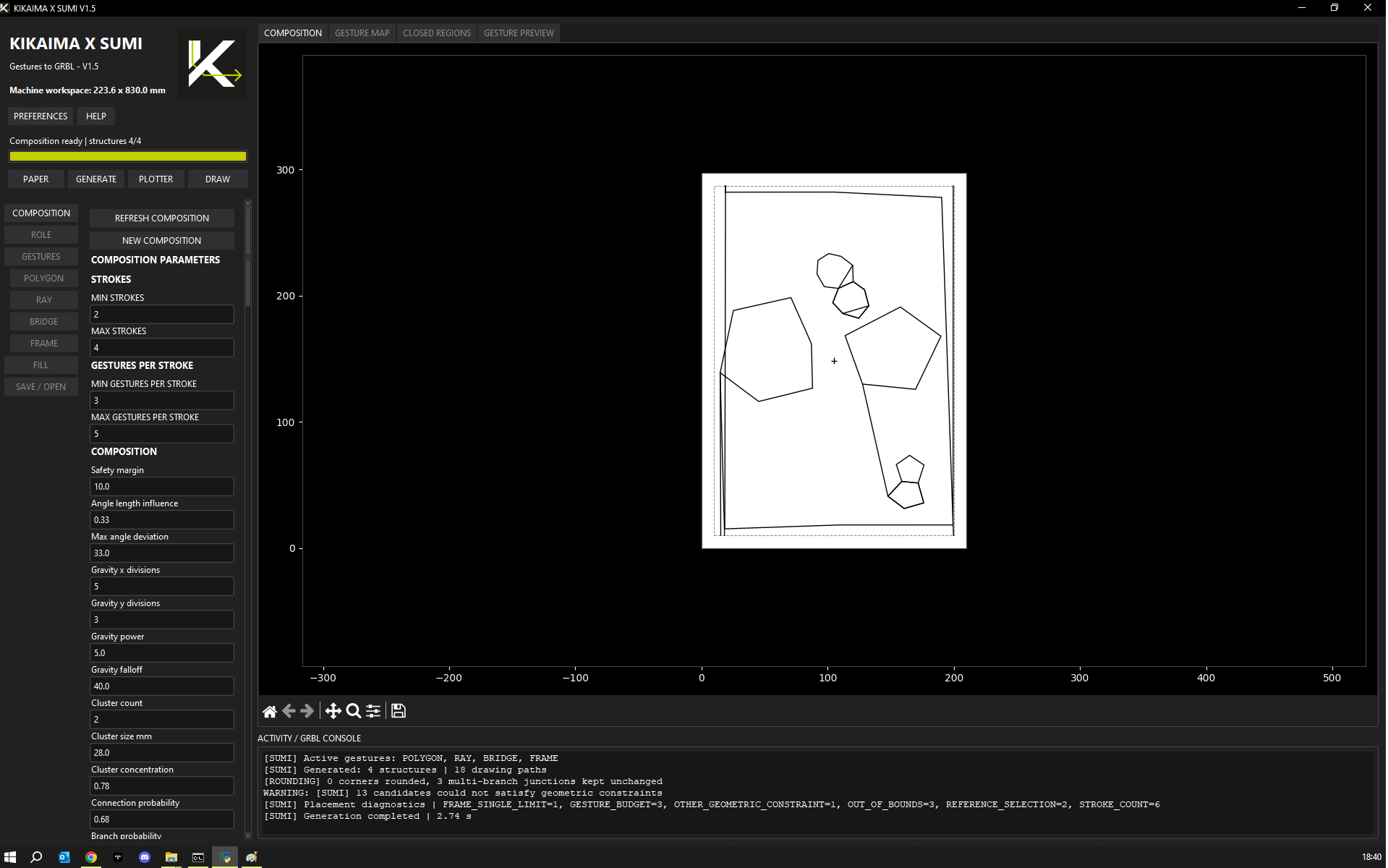
When we draw a closed shape, it is easy to tell what belongs inside it and what remains outside. But what if we want to colour the background? And what if a line crosses the entire sheet and divides the space in two? In that case, even without two independently enclosed shapes, we can read the line as creating two different regions.
To explore these possibilities, I began treating the paintable margins of the paper as another boundary within the composition. That way, the background itself could be understood as a bounded surface, and therefore as an area that could be filled with colour.
The solution made sense, but visually it didn't quite convince me. Filling a surface up to a perfectly regular edge felt too cold, almost like colouring in a rectangle. I wanted that boundary to carry something of a gesture too, rather than always being so precise and uniform.
That's how FRAME came about.
The idea is to introduce an imperfect frame close to the edges of the paper, with variations and irregularities that change its path. It can also be fragmented, stopping in some places and leaving other areas open. The border then stops being merely a boundary and begins to take part in constructing the image.
There is another concept that has always interested me and that I see as connected to FRAME: photographic reframing. When working from a negative and making an enlargement, we can decide which part of the image to keep, which elements to leave out, or how the composition changes when its limits move. A seemingly simple decision can completely transform the way a photograph is read.
With FRAME I want to bring part of that idea into SUMI's language. The frame does not have to coincide with the physical edge of the paper, nor does it have to be a perfectly closed shape. It can establish new limits within the composition, introduce irregularities, or give certain areas a stronger presence than others.
This also makes me reconsider the relationship between figure and ground. Negative space does not have to be simply what remains empty between the drawn elements. It can become a region with an identity of its own, even another figure within a larger one, ultimately bounded by the paper itself.
What began as a need to visualise areas of colour has opened up another question about composition: to what extent is the boundary of an image part of its language?
FRAME is one way for me to explore that question, bringing the border into the vocabulary of gestures and allowing its irregularities to become part of the result.
English translation awaiting approval; additional photographs pending.